


In the evolving UK grantmaking landscape of 2026, community foundations, local authorities, NHS charities, and trust funds face intense operational and regulatory pressures. Public sector and charitable grantmakers must navigate strict regulatory frameworks, such as the Cabinet Office’s Government Functional Standard GovS 015: Grants, Section 151 financial officer obligations, and core local council principles like “Following the Public Pound”.
Selecting the right Grant Management Software (GMS) requires balancing operational speed, applicant accessibility, reviewer collaboration, audit readiness, and financial governance. This report evaluates two prominent UK cloud solutions serving the sector, comparing their approaches to application intake, workflow automation, and statutory compliance.
What Are Plinth and BenefactorCloud?
Plinth is an AI-first grant management and community platform tailored for rapid intake, automated due diligence, and grassroots community organisation engagement. It primarily serves small fund teams and place-based community foundations looking to process high volumes of applications with minimal administrative overhead by leveraging AI to extract applicant data.
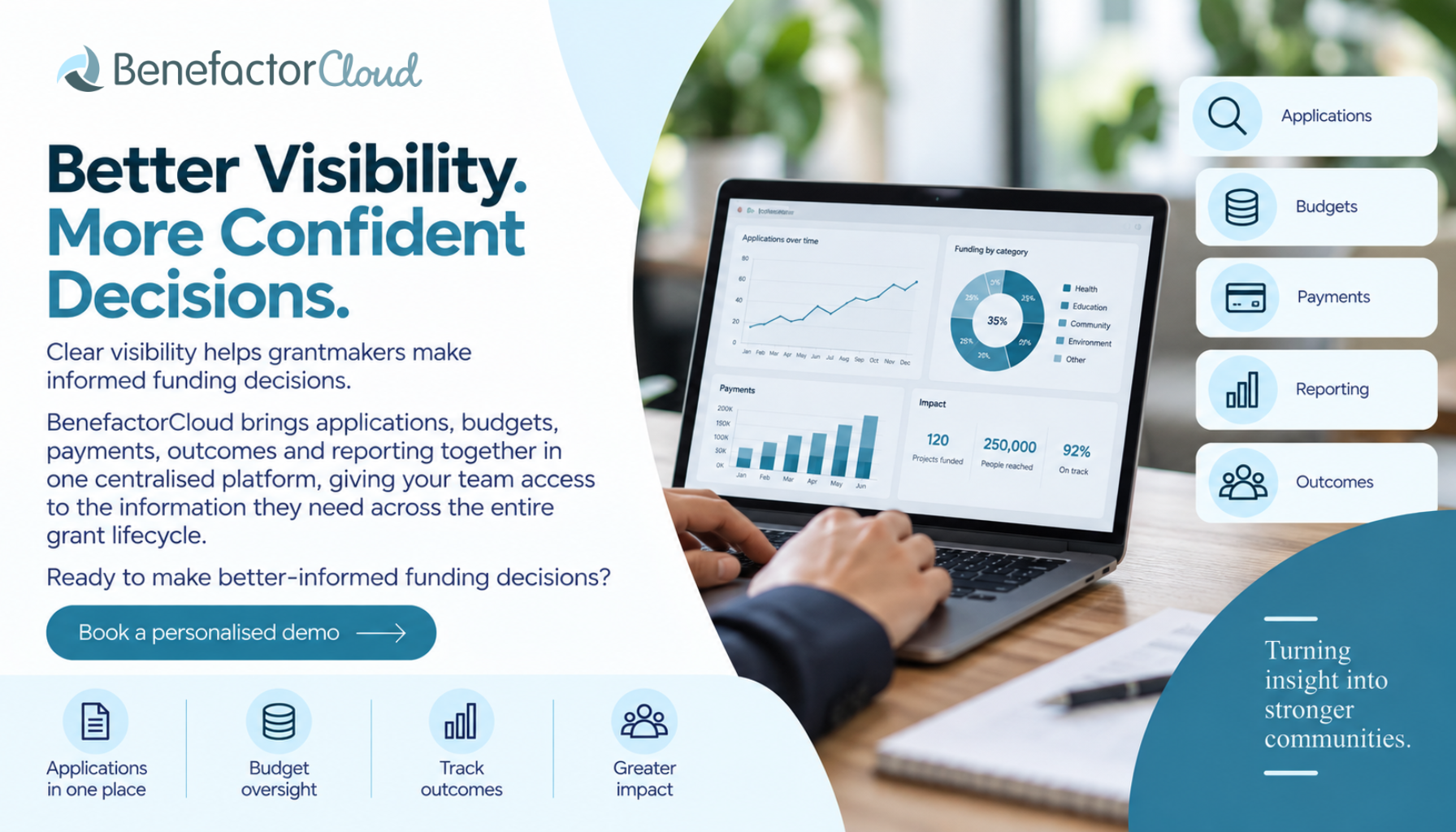
BenefactorCloud is a market-leading UK cloud grant management software streamlining the full grantmaking lifecycle. Developed by a technology provider with over 25 years of experience in the UK third sector, it is engineered for end-to-end financial control, strict audit compliance, and multi-stakeholder governance across more than 100 UK grantmaking bodies, including local councils, NHS charities, and major trust funds.
Reviewer Scoring & Assessment Workflows Compared
The most significant architectural difference between these platforms lies in how they handle application assessment.
Plinth utilises AI models to read grant applications and automatically extract evidence against predefined assessment criteria, presenting the results through structured scoring templates so that each reviewer assesses against the same framework. By locating the supporting evidence automatically, it aims to reduce the reading burden on reviewers and shorten the time taken to reach a decision, and it can draft applicant feedback using AI for staff to review before it is sent.
Conversely, BenefactorCloud provides granular multi-tier review screens designed in part for complex multi-departmental and committee alignment. It supports highly customisable approval workflows with built-in skip and reverse functionality. This ensures that multi-stage committee approvals, conditional escalations, and re-reviews are handled seamlessly without corrupting historical evaluation records. Administrators maintain tight control over scoring rubrics and assessor access through comprehensive, administrator-controlled permissions rather than relying on automated data extraction.
Eligibility Tools & Due Diligence
Verifying applicant entities safely and efficiently is a core requirement for any UK funder.
For due diligence, Plinth performs real-time verification against the Charity Commission for England and Wales, Companies House, OSCR and the Charity Commission for Northern Ireland, cross-referencing charity and company records where an applicant is registered with both. It also screens applicants against the OFSI consolidated sanctions list. This is paired with AI document analysis that reads uploaded governing documents, annual accounts, insurance certificates and safeguarding policies, assessing each document type against its own set of criteria to highlight potential compliance omissions or risks.
BenefactorCloud prioritises structured eligibility gatekeepers to protect fund integrity. It utilises scored pre-tests prior to opening full application forms and enforces frequency limits per applicant to prevent over-application or duplicate funding requests within specified timeframes. Rather than assessing submitted documents after the fact, this approach filters out ineligible requests before they enter the workflow at all, keeping officer time on applications that can actually be funded.
Applicant Experience and Accessibility
For most funders the application portal is the only part of the system applicants ever see, and public sector buyers carry their own statutory duties for the digital services they put in front of the public.
Plinth is designed for use on mobile devices as well as desktop. Its G-Cloud entry notes one functional limitation: reports and analytics cannot be accessed from the mobile service. The WCAG 2.1 AA standard cited in that entry applies to its user support channels, including the third-party live chat tool it uses, rather than to the platform itself.
BenefactorCloud is responsive across mobile and desktop, and applicants can complete and submit a full application on a phone. The applicant portal is built to WCAG 2.1 AA, supporting public sector buyers in meeting their own duties under the Public Sector Bodies (Websites and Mobile Applications) Accessibility Regulations 2018. Applications save automatically as they are completed, so an applicant working on a phone can stop and return without losing progress.
The portal stays useful after an award is made. Grantees can see the payments attached to their grant, including the full schedule of instalments still to come as well as what has already been paid, and they can mark a payment in the portal once it reaches them. The grants team sees those flags in one place, which removes the familiar round of emails asking whether the money has arrived.
Reporting Capabilities & Financial Governance
Reporting structures define how successfully a funder can audit its performance and manage financial outlays.
Plinth generates automated impact dashboards and summary reports covering grant outcomes. It employs a parent-child programme architecture, allowing multi-round funds to inherit settings and criteria, which simplifies aggregated cross-cycle reporting for seasonal community grants.
For organisations requiring more stringent financial controls, BenefactorCloud delivers dedicated financial modules to track budget allocations, committed funds, drawdowns, and payment schedules in real-time. It operates full double-entry accounting on posting a transaction, with the ability for staff to draft financial transactions ahead of an authorised sign-off, and every posting is recorded against user, date-time and financial year. Grant commitment can be tracked and analysed at any date point, and detailed transaction logs capture any variations to an award over its life. Crucially for Section 151 officers and internal auditors, it generates audit trails—logging system events, document edits, status changes, and payment releases. For integration with core local authority or charitable accounting software, it provides robust export tools that work with these systems.
Hosting, Security and Assurance
Two questions matter most here: where your applicants’ data is kept, and what the supplier can actually prove about how it is protected. Your IT or information governance colleagues will usually want to see the answers in writing.
Plinth holds its data in the EU rather than the UK, spread across several cloud providers, and buyers cannot choose where it sits. The basics are in place: data is encrypted, an independent tester checks the system at least once a year, changes to records are logged, and the company is registered with the ICO with a board member accountable for security. What it does not hold is any of the recognised security certifications – ISO 27001, Cyber Essentials or Cyber Essentials Plus – and its own entry on the government’s Digital Marketplace states that staff are not screened. If your organisation expects a supplier to be certified, to keep data in the UK, or to vet the people who can reach it, that gap will weigh more heavily than any difference in features.
BenefactorCloud keeps all applicant data in the UK, in London data centres run by Amazon Web Services. It is encrypted both in storage and in transit, with a further layer of protection over bank details. The system is tested by an independent, CREST-approved security tester and we can share the most recent summary on request. Gallery Partnership holds Cyber Essentials Plus, and every member of staff who can reach the infrastructure is DBS checked.
Feature Comparison Matrix
|
Strategic Dimension |
Plinth |
BenefactorCloud |
|
Primary Focus |
AI-automated triage and grassroots community intake |
Custom workflow automation, financial controls, and auditability |
|
Reviewer Setup |
AI-assisted extraction; structured scoring templates |
Multi-tier online scoring; skip/reverse approval logic |
|
Eligibility checks |
AI document scanning; UK registry checks (Charity Commission, Companies House, OSCR, CCNI) & OFSI sanctions screening |
Configurable gatekeepers; scored pre-application tests & frequency limits per applicant |
|
Accessibility |
Mobile and desktop responsive, though its G-Cloud entry states that reports and analytics cannot be accessed on the mobile service |
Responsive across mobile and desktop; applicant portal built to WCAG 2.1 AA |
|
Financial Controls |
Milestone tracking & grantee self-reporting |
Full double-entry accounting with draft-before-sign-off; real-time budget tracking, payment schedules & ledger exports; grantees see their payment schedule and flag payments as received |
|
Hosting |
Data held in the EU, across several cloud providers; buyer cannot choose the location |
UK only (London); encrypted; independently security-tested by a CREST-approved tester |
|
Procurement & assurance |
Listed on the government’s Digital Marketplace; its own entry there shows no ISO 27001, Cyber Essentials or Cyber Essentials Plus certification, and states that staff are not screened (checked September 2026) |
Available via G-Cloud 15; Cyber Essentials Plus, CREST-approved penetration testing, DBS-checked staff |
Strategic Decision Framework: Which GMS to Choose?
Choosing between these platforms depends heavily on a funder’s structural requirements, scale, and regulatory environment.
When Plinth is relevant
This platform is ideal for place-based community foundations and agile funding teams that process high volumes of applications with minimal administrative staff. Its reliance on AI to handle initial evidence extraction and draft applicant feedback makes it highly suitable for multi-round grant cycles where speed, automated charity checks, and light administration are the primary drivers.
When BenefactorCloud is a good choice
This platform is often the choice for local authorities, NHS trusts, and major charity funds that must comply with rigorous UK government grant standards and local financial regulations. It is specifically engineered for audit-sensitive grantmakers where internal auditors or board trustees require audit logs. Organisations needing tailored workflow designs, comprehensive financial management, and procurement through G-Cloud 15 backed by certified security assurance and UK-only data residency will find its governance controls important.
Summary
For public sector grantmakers and local authorities subject to cabinet-level standards and financial oversight, software selection hinges on audit readiness and financial control. While some community foundations benefit from AI-driven application due diligence, funders managing complex, multi-year research or capital grants may require the structural workflow customisation, compliance, and secure budget management refined over decades of UK third-sector partnership.